
What is the post-treatment protocol for de-icing services?
Q - What is the difference between post-treatment and pre-treatment or "anti-icing"?
A - Anti-icing prevents snow and ice from binding to the pavement, making snow and ice easier to remove and faster to melt. It’s a proven method to reduce chlorides. While anti-icer does provide melting power for initial snow accumulation, it is not meant to prevent snow from laying on the surface; it is specifically meant to create a protective layer over the asphalt so that snow and ice do not compact and become bonded with the pavement surface. Post-treatment is different as it targets snow or ice already on the surface.
Q - When does post-treatment occur?
A - Post-treatment typically occurs during a storm where surface conditions deteriorate, forming an ice pack. Reducing slippery conditions is essential for supporting heavy equipment during snow-clearing operations and enabling TOM teams to continue functioning. Post-treatment is also deployed after final cleanup to eliminate the small film left on paved surfaces after completing plowing and snow-clearing operations.
Q - How do operations decide when to utilize liquid de-icers vs traditional rock salt?
A - Liquid deicers are preferred when temperatures drop below 18 degrees; they become critical when temperatures drop below 10 degrees. When temperatures drop below 10 degrees, the endothermic reaction of rock salt halts, leaving rock salt ineffective. Rock salt is preferred during warmer temperatures and is essential when winter storms have mixed precipitation. This is especially true during freezing rain events.
Q - How much material is applied if dry rock salt is used?
A - One-quarter ton per acre per application
Q - If onsite leadership requests de-icing between cars, what is the proper procedure?
A - Unless the film of snow or ice is very thin, 1/8 - 1/4" the snow or ice pack must be cleared using mechanical or hand labor methods, otherwise the application of de-icers will cause the ice pack to melt only to a degree, then refreeze into black ice. The proper time to de-ice between associate cars or deliver vans is at the end of a storm when the final clean-up occurs.
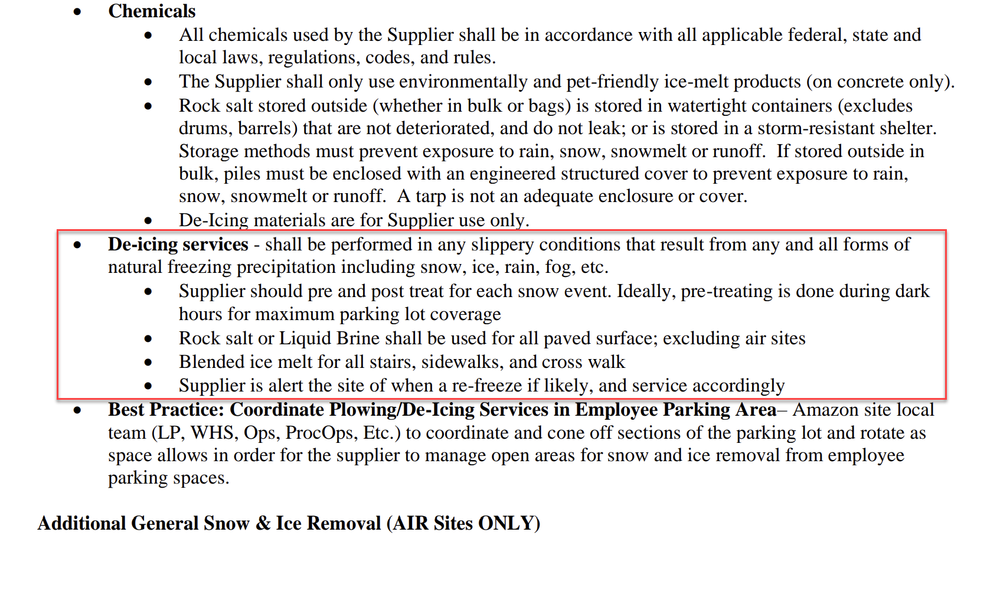
Amazon SOW "De-Icing Services"
A - Anti-icing prevents snow and ice from binding to the pavement, making snow and ice easier to remove and faster to melt. It’s a proven method to reduce chlorides. While anti-icer does provide melting power for initial snow accumulation, it is not meant to prevent snow from laying on the surface; it is specifically meant to create a protective layer over the asphalt so that snow and ice do not compact and become bonded with the pavement surface. Post-treatment is different as it targets snow or ice already on the surface.
Q - When does post-treatment occur?
A - Post-treatment typically occurs during a storm where surface conditions deteriorate, forming an ice pack. Reducing slippery conditions is essential for supporting heavy equipment during snow-clearing operations and enabling TOM teams to continue functioning. Post-treatment is also deployed after final cleanup to eliminate the small film left on paved surfaces after completing plowing and snow-clearing operations.
Q - How do operations decide when to utilize liquid de-icers vs traditional rock salt?
A - Liquid deicers are preferred when temperatures drop below 18 degrees; they become critical when temperatures drop below 10 degrees. When temperatures drop below 10 degrees, the endothermic reaction of rock salt halts, leaving rock salt ineffective. Rock salt is preferred during warmer temperatures and is essential when winter storms have mixed precipitation. This is especially true during freezing rain events.
Q - How much material is applied if dry rock salt is used?
A - One-quarter ton per acre per application
Q - If onsite leadership requests de-icing between cars, what is the proper procedure?
A - Unless the film of snow or ice is very thin, 1/8 - 1/4" the snow or ice pack must be cleared using mechanical or hand labor methods, otherwise the application of de-icers will cause the ice pack to melt only to a degree, then refreeze into black ice. The proper time to de-ice between associate cars or deliver vans is at the end of a storm when the final clean-up occurs.
Amazon SOW "De-Icing Services"
Learn about how East Coast Facilities prepares your site for winter weather operations.
sweetprocess.com/video/6WAmFqAO.mp4-
1Determine proper melting agentsOperations managers review the weather forecasts from assigned trueWeather forecasters and determine what material should be utilized.
Operators will consider ambient, paved surface temperatures, and precipitation type in storm and post-storm.
Liquids will be deployed when temperatures fall below 10 degrees. When conditions are above 10 degrees, Operations may select the proper melting agents based on site-specific needs and product availability. -
2Apply liquid de-icer
-
3Apply rock salt
-
4End
If you still have a question, we’re here to help. Contact us