
What is the pre-treatment protocol for anti-icing services?
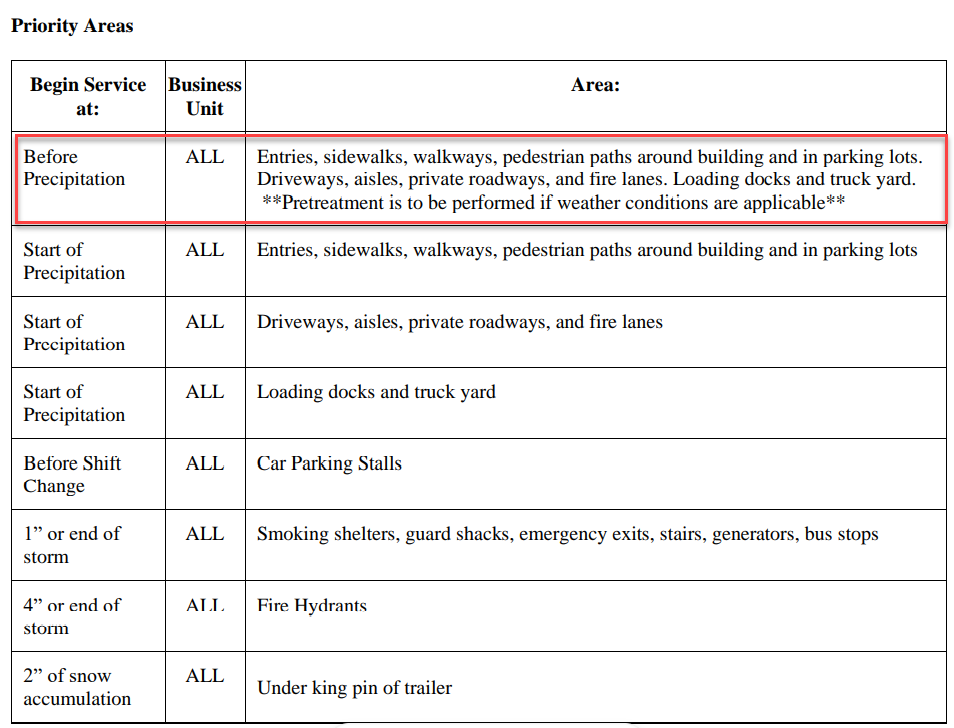
Q - What is the purpose of pre-treatment, otherwise known as Anti-Icer?
A - Anti-icing prevents snow and ice from binding to the pavement, making snow and ice easier to remove and faster to melt. It’s a proven method to reduce chlorides. While anti-icer does provide melting power for initial snow accumulation, it is not meant to prevent snow from laying on the surface; it is specifically meant to create a protective layer over the asphalt so that snow and ice do not compact and become bonded with the pavement surface. Liquid or dry rock salt can be used. Liquid is often preferred but is not widely accessible in the market.
Q - When can pre-treatment occur?
A - Pretreatment can occur up to 72 hours before a storm system when liquid is utilized, provided the blend has an additive such as Headwaters Hot or AMP. If dry rock salt is used, it should be done within 24 hours of the forecasted accumulation start.
Q - How much material is applied if liquids are being deployed?
A - 20 gallons per acre
Q - How much material is applied if dry rock salt is used?
A - One-quarter ton per acre.
Amazon SOW
What do liquid anti-icing operations look like?
sweetprocess.com/video/J7KQsPaY.mp4
A - Anti-icing prevents snow and ice from binding to the pavement, making snow and ice easier to remove and faster to melt. It’s a proven method to reduce chlorides. While anti-icer does provide melting power for initial snow accumulation, it is not meant to prevent snow from laying on the surface; it is specifically meant to create a protective layer over the asphalt so that snow and ice do not compact and become bonded with the pavement surface. Liquid or dry rock salt can be used. Liquid is often preferred but is not widely accessible in the market.
Q - When can pre-treatment occur?
A - Pretreatment can occur up to 72 hours before a storm system when liquid is utilized, provided the blend has an additive such as Headwaters Hot or AMP. If dry rock salt is used, it should be done within 24 hours of the forecasted accumulation start.
Q - How much material is applied if liquids are being deployed?
A - 20 gallons per acre
Q - How much material is applied if dry rock salt is used?
A - One-quarter ton per acre.
Amazon SOW
What do liquid anti-icing operations look like?
sweetprocess.com/video/J7KQsPaY.mp4
-
1Determine viabilityOperations managers review the weather forecasts from assigned trueWeather forecasters and determine if pre-treatment is necessary, and what type of material should be utilized.
Pavement temperature forecasts will be the core consideration. -
2Determine product choiceShould liquid or rock salt be deployed?
-
3Apply liquid anti-icer
-
4Apply rock salt
-
5End
If you still have a question, we’re here to help. Contact us